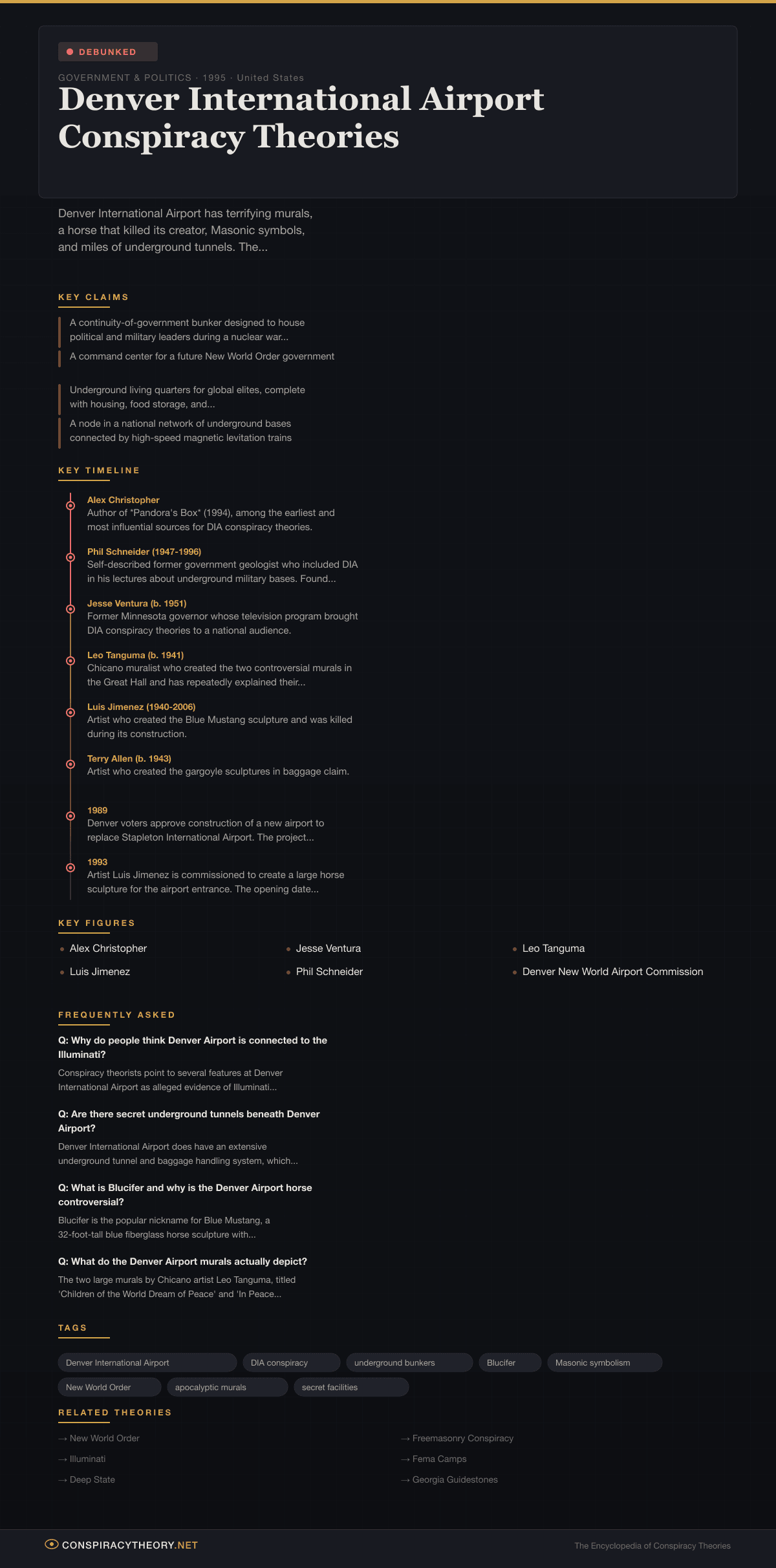
Denver Airport Conspiracy

Overview
Thirty years after its controversial opening, Denver International Airport remains one of the most fertile grounds for conspiracy theory in the United States. It is not merely the sheer accumulation of strange details that draws researchers and theorists — though there are many — but the pattern those details seem to form when viewed together. A budget that doubled. A location that defies commercial logic. Apocalyptic artwork commissioned with public funds and installed in full view of millions of travelers. A dedication stone bearing the name of an organization that, by all available evidence, does not exist. An underground construction project of extraordinary scale. A statue that killed its own creator.
Each of these elements, in isolation, has a conventional explanation. Taken together, they form the backbone of one of the most enduring and elaborately documented conspiracy theories in modern American history — the denver airport conspiracy. Whether one interprets DIA as a monument to hidden power or simply as a uniquely troubled public works project, the airport has become a cultural landmark not just for Colorado, but for anyone interested in the intersection of public infrastructure, secret societies, and what theorists call the New World Order agenda.
This article examines the key claims surrounding DIA, the evidence that supports and complicates each one, and the broader cultural phenomenon the airport has become — one so widely known that airport management itself has begun leaning into the legend.
Origins of the Theory
Denver International Airport opened on February 28, 1995 — sixteen months behind its original schedule and approximately $2 billion over budget. What was projected as a $1.7 billion project ultimately cost taxpayers $4.8 billion by the time the doors opened, making it one of the most expensive airport constructions in American history at that time. These financial irregularities alone would have drawn scrutiny, but the problems ran deeper.
Almost immediately after opening, observers began cataloguing a series of anomalies. Investigative journalists, local residents, and later internet researchers began connecting dots between the airport’s artwork, its physical footprint, its underground infrastructure, and its symbolic decorations. The theories accelerated through the late 1990s as the early internet gave researchers tools to compare notes, cross-reference sources, and reach audiences beyond their local communities.
The DIA conspiracy gained additional momentum in the mid-1990s through the testimony of Phil Schneider, a self-described government geologist and engineer who claimed to have participated in the construction of classified underground bases across the United States. Before his death in 1996 — officially ruled a suicide, though his supporters dispute this — Schneider gave a series of lectures in which he described DIA as containing a massive underground facility connected to a network of deep underground military bases, allegedly built to house global elites in the event of a catastrophic depopulation event. Schneider’s claims remain unverified, but they established a framework through which subsequent researchers would interpret everything else they found at the airport.
Key Claims
The Leo Tanguma Murals: A Blueprint for Genocide?
Of all the elements associated with the denver airport conspiracy, none generates more sustained discussion than the two large mural series commissioned from Chicano artist Leo Tanguma. Spanning thousands of square feet across the airport’s main terminal, the murals are impossible to ignore — and nearly impossible to interpret without forming an opinion.
The first series, titled In Peace and Harmony with Nature, depicts an idealized natural world followed by scenes of devastating environmental collapse: dead animals, a weeping child clutching an extinct bird wrapped in a white sheet, forests in flames, and rivers choked with pollution. The second series, Children of the World Dream of Peace, contains the imagery that has most alarmed observers. A central panel shows an enormous gas-masked soldier — uniformly described by theorists as resembling a figure from a totalitarian state — wielding a large scimitar over a field of dead and dying civilians. Mothers clutch dead infants. Children lie in coffins. Buildings burn in the background. In another panel, a line of women in national dress carries offerings forward beneath what appears to be a militarized, oppressive sky.
The murals then pivot. In their concluding panels, children from nations across the world surround a large central figure, swords are beaten into plowshares, and nature is restored. Tanguma has consistently and publicly stated that the murals depict humanity’s journey through war and environmental destruction toward ultimate peace — a message of hope encoded in the contrast between horror and harmony.
Conspiracy theorists read the same imagery through a different lens. In this interpretation, the gas-masked soldier is not a symbol of war to be overcome but a symbol of the intended agent of a coming purge. The children in coffins represent planned casualties of a global depopulation event. The national dress of the mourning women is taken as evidence that the murals depict a specifically globalist program — the dismantling of national identity and the imposition of a unified world system under a single power structure. The final panels, in this reading, do not depict peace freely achieved but submission to a new order — the New World Order — that emerges from deliberate catastrophe.
The fact that these images were funded by public money, installed in a government-built transit hub, and remain on display to this day is, for many theorists, itself evidence. The question they pose is simple: why would an airport commission and display imagery of mass death, burning cities, and dead children — unless those commissioning it intended it as a message to those who knew how to read it?
Blucifer: The Statue That Killed Its Creator
Standing 32 feet tall at the entrance road to Denver International Airport, the sculpture officially titled Blue Mustang has earned a different name from locals and travelers alike: Blucifer. The reasons are not difficult to understand. The horse is an electric, vivid blue. Its musculature is exaggerated to the point of violence. And its eyes glow red — not by accident, but by design. At night, the effect is genuinely unsettling, a massive demonic-looking horse standing sentinel at one of the busiest airports in North America.
What elevates Blucifer from mere aesthetic controversy to conspiracy lore is the fate of its creator. New Mexico sculptor Luis Jimenez had been commissioned to create the work in 1993. Work on the piece extended for more than a decade — far beyond original projections, in a pattern that would feel familiar to anyone studying DIA’s broader construction history. In June 2006, a section of the sculpture fell on Jimenez in his studio, severing an artery in his leg. He bled to death from the wound. He was 65 years old.
The statue was completed by Jimenez’s family and studio assistants and installed at DIA in 2008. The red eyes were part of Jimenez’s original design, intended to honor the wild mustang spirit of the American West. Officially, the installation is described as a tribute to the artist’s vision and legacy.
For those following the denver illuminati thread, however, the circumstances carry a different weight. A statue commissioned for a deeply controversial airport, delayed for over a decade, killing its own creator before completion, installed posthumously with glowing red eyes at the gateway to an alleged underground complex — these details have become part of a larger narrative about the airport as an inherently cursed or deliberately malevolent project.
The Underground Tunnel System and Alleged Bunker Complex
DIA sits on 53 square miles of land on the eastern plains of Colorado. To put that figure in context, the island of Manhattan covers approximately 23 square miles. Denver International Airport’s footprint is more than twice the size of Manhattan. For an airport serving a metropolitan area of roughly three million people, the land allocation is, by any conventional metric, extraordinary.
The surface area alone raises questions, but the underground infrastructure raises more. DIA contains an extensive below-grade tunnel system, originally built to house an ambitious automated baggage-handling system — itself one of the most troubled components of the airport’s construction, plagued by mechanical failures so persistent that the system was eventually largely abandoned. The tunnels remain. Trains run through them. Workers use them. But the full extent of what lies beneath DIA has never been subject to independent public audit.
Construction records, partially obtained through public records requests over the years, confirm one striking fact: during construction, five large buildings were fully built underground and then buried. The official explanation is straightforward — the buildings were constructed incorrectly and, rather than being demolished and removed, were buried in place and used as a foundation for subsequent construction. This explanation is plausible. It is also, as many researchers note, precisely the kind of explanation that would be given if those structures had been intentionally concealed.
The denver airport underground bunker theory holds that beneath the civilian airport lies a continuity-of-government facility — a deep underground complex designed to shelter global elites, political leadership, or both in the event of a large-scale catastrophic event. Proponents point to the airport’s isolated location, its extraordinary land footprint, its buried structures, its tunnel network, and its proximity to Cheyenne Mountain (home to NORAD) as a coherent pattern rather than a series of unrelated facts. No official confirmation of any such facility has ever been issued, and no verified photographic or documentary evidence of a bunker complex has been publicly produced.
The Masonic Capstone and the New World Airport Commission
Set into the floor of the Great Hall at Denver International Airport is a large granite capstone — a dedication marker of the type traditionally used at the completion of significant buildings. The stone bears a time capsule to be opened in 2094. It is inscribed with the names of those who oversaw the airport’s construction, including then-Denver Mayor Federico Pena and his successor Wellington Webb. It features Masonic symbols, including the compass and square associated with Freemasonry. And it bears the name of the organization that apparently sponsored the dedication: the New World Airport Commission.
No organization by that name appears in any public registry of corporations, nonprofits, civic organizations, or government bodies. Researchers have searched Colorado state records, federal filings, and municipal archives. The New World Airport Commission does not appear to have existed before the dedication stone was made, and it does not appear to have existed after. Airport officials have stated that the name was created specifically for the dedication ceremony — essentially a ceremonial title with no organizational substance behind it.
For those tracking the denver illuminati connection, the stone is among the most discussed pieces of evidence in the entire DIA file. The reasoning is layered. First, the name itself: “New World” is the precise language used in references to the New World Order, the alleged global governance project attributed to elite secret societies including the Illuminati. Second, the Masonic imagery: Freemasonry has long been associated in conspiracy research with the same networks said to be driving the New World Order agenda. Third, the non-existence of the commission: if the name was truly ceremonial, why choose one with such specific and loaded language? Why not “Denver Airport Dedication Committee” or any number of neutral alternatives?
The capstone remains in place today, readable by any traveler who pauses to look at the floor of the Great Hall.
Gargoyles in Baggage Claim
Less commented upon than the murals or the capstone, but no less strange to first-time visitors, are the bronze gargoyles installed in the airport’s baggage claim areas. The sculptures depict the creatures emerging from vintage steamer trunks, their wings folded, their expressions watchful. Small plaques beside them read: “Il Gargoyle — Guardian of the Airport.”
Gargoyles have a long history in European ecclesiastical architecture, where they served both functional purposes (as waterspouts) and symbolic ones (as ward-demons placed to guard sacred spaces from malevolent forces). Their presence in a 20th-century American airport terminal is, architecturally, without obvious precedent. In the context of the broader DIA conspiracy, the gargoyles are interpreted as markers — symbols of occult guardianship placed deliberately at transition points in the building, consistent with ritual practices attributed to secret societies that, according to certain research traditions, encode their symbols into significant public buildings.
Construction Anomalies: Buried Buildings and a Ballooning Budget
The documented construction history of Denver International Airport is, independent of any conspiracy framework, genuinely remarkable. The original budget of approximately $1.7 billion grew to $4.8 billion by the time the airport opened in February 1995 — an overrun of more than 180 percent. The opening was delayed by sixteen months. The automated baggage system, which was central to the airport’s design concept and a significant driver of both cost and delay, never functioned reliably and was eventually decommissioned at considerable additional expense.
The five buried buildings represent a particularly unusual data point. Standard construction practice, when a structure is found to be built incorrectly, involves assessment, correction, or demolition. Burial — encasing entire buildings in earth and building over them — is far less common and considerably more expensive than demolition. The decision to bury rather than demolish is one that airport authorities have not explained in detail beyond characterizing it as a construction error correction. Independent structural or construction engineers have not been given public access to assess what is underground.
The Location Question: Why 25 Miles From Downtown?
Denver’s previous primary commercial airport, Stapleton International, was located approximately six miles from downtown Denver. It was close, convenient, and — though aged and capacity-constrained by the 1980s — functionally adequate for the city’s needs. The decision to replace it with a new facility located 25 miles from downtown on isolated plains to the east was justified on several grounds: noise complaints from surrounding neighborhoods, the need for additional runways, and the desire for room to expand.
These are legitimate planning concerns. But the scale of the relocation — from six miles to 25, and from a manageable urban footprint to 53 square miles of largely undeveloped land — represents a decision of unusual magnitude. Airports in comparable cities are not typically located 25 miles from their downtown cores. The inconvenience to travelers is measurable, and the cost of transportation infrastructure to connect the distant airport to the city has been substantial.
Theorists point to the location as strategic rather than civic: a large, isolated, federally proximate facility on flat terrain with extensive underground development, far enough from population centers to limit casual scrutiny, close enough to existing government infrastructure (Cheyenne Mountain, various federal facilities along the Front Range) to be operationally integrated with continuity-of-government planning.
Evidence
The evidentiary foundation for DIA conspiracy theories rests on several documented facts that have been independently verified:
The murals exist and contain the imagery described. They are publicly visible and have been widely photographed. The Masonic capstone exists, bears the name “New World Airport Commission,” and no such organization can be found in public records. The automated baggage tunnel system was built, failed, and was partially abandoned. Construction costs did double. The airport did open 16 months late. Five structures were buried during construction, confirmed in construction documentation. Luis Jimenez did die in 2006 when his own sculpture fell on him. The airport does occupy 53 square miles. The gargoyles are present. Blucifer’s eyes do glow red.
These are not theoretical claims — they are confirmed, observable, or documented facts. The conspiracy interpretation is not that these facts are invented but that their combination is too consistent to be coincidental.
Counterarguments
Proponents of conventional explanations offer the following responses to the major claims:
The murals, they argue, are straightforwardly anti-war public art, consistent with Tanguma’s documented body of work and his stated artistic philosophy. The artist has given interviews explaining each panel in detail. The fact that the imagery is dark does not make it sinister — public art depicting war’s horrors has a centuries-long tradition.
The budget overruns and delays, while extreme, are not historically unparalleled in large-scale public infrastructure projects. The Denver automated baggage system was an ambitious, largely untested technology. The buried buildings were an embarrassing construction error in a high-profile project — the kind of mistake that institutions prefer to quietly address rather than advertise.
The New World Airport Commission name, officials say, was selected as a grandiose-sounding ceremonial title with no deeper meaning. The Masonic imagery reflects the presence of Freemasons among the city’s civic leadership — a historically common pattern in American cities rather than evidence of occult planning.
The airport’s size and location reflect long-term regional planning rather than covert facility design. Denver’s population and air traffic were projected to grow significantly, and the land acquisition was intended to allow expansion for generations.
The gargoyles are whimsical art installation choices, consistent with an airport that commissioned significant public art throughout its terminal spaces.
Blucifer killed its creator through a tragic workshop accident, not supernatural agency.
These counterarguments are reasonable. Whether they are fully satisfying depends on the weight one assigns to the cumulative pattern.
Cultural Impact
The DIA conspiracy has achieved something unusual for a theory of its type: it has become mainstream enough that the airport’s management has incorporated it into the institution’s public identity. Signage during recent construction phases has included messages like “Construction zone: we are building a new world order” — a direct wink at the conspiracy theories that have surrounded the airport for three decades. The airport’s official social media accounts have engaged with the theories humorously. Gargoyle selfie spots are marked. The capstone is highlighted on official airport maps.
This embrace of conspiracy lore is a striking institutional choice. It functions simultaneously as a good-humored public relations strategy and as what some theorists describe as a form of “revelation of the method” — the idea, rooted in certain occult traditions, that those who carry out hidden agendas are obligated to, or gain power from, revealing what they are doing in plain sight. Whether DIA’s marketing department is deflecting public concern through humor or — in a more theoretically charged reading — engaging in an older practice of open concealment is, like much else about the airport, a matter of interpretive perspective.
The DIA conspiracy has influenced broader popular culture significantly. It has appeared in television documentaries, podcast series, YouTube investigations, and academic papers examining the sociology of conspiracy belief. It is taught in media literacy courses as an example of how documented anomalies can be assembled into conspiratorial narratives. It features regularly in discussions of the Illuminati, depopulation agendas, FEMA camps, and underground bases — making DIA a kind of connective tissue between several overlapping conspiracy frameworks.
It has also had a measurable effect on tourism. Travelers deliberately route layovers through Denver to see the murals, photograph the capstone, and confront Blucifer on the entrance road. The airport has become, in a very real sense, a conspiracy destination.
Current Status
As of 2026, the core elements of the DIA conspiracy remain unresolved in the sense that matters most to serious researchers: no independent audit of the underground facilities has been conducted, no membership list for the New World Airport Commission has surfaced, and no official accounting of the buried structures has been made publicly available in any level of detail sufficient to close the question.
The murals remain installed, though the airport has undergone renovations and some artwork has been relocated within the terminal. Blucifer continues to greet arrivals on the entrance road with glowing red eyes. The gargoyles remain in baggage claim. The capstone remains in the floor of the Great Hall.
The airport continues to expand. Major construction projects in recent years have involved further underground utility and infrastructure work. The automated baggage tunnels, whatever their current operational status, remain in place beneath the terminal complex.
Phil Schneider is dead. Leo Tanguma is elderly. Luis Jimenez’s family completed his final work. The principals of the airport’s original construction era have largely moved on from public life. The documentary record that exists is the documentary record that is likely to exist — partial, bureaucratic, and not designed to answer the questions that conspiracy researchers most want answered.
Conclusion
Denver International Airport is many things at once. It is a functional commercial aviation hub serving tens of millions of passengers per year. It is a troubled public works project whose documented history of cost overruns, delays, and construction anomalies would warrant scrutiny independent of any conspiracy framework. It is a gallery of unusually provocative public art, including murals depicting scenes that no dispassionate observer would describe as typical airport decoration. It is a site of documented Masonic symbolism connected to an organization that cannot be traced in any public record. And it sits on a plot of land far larger than anything a commercial airport of its size and location could plausibly require, above an underground infrastructure whose full extent has never been publicly established.
The denver airport conspiracy is not a fringe preoccupation. It is the product of careful observation of genuinely anomalous facts, organized into a framework that attempts to explain why an airport built with public money, in a democratic country, with full public accountability in theory, contains so many elements that resist simple explanation. Whether one concludes that DIA’s peculiarities reflect organizational dysfunction, artistic ambition, civic ego, and bad luck — or something more deliberately constructed — the anomalies themselves are real.
What the airport is hiding, if it is hiding anything, remains unknown. What it is showing — to anyone willing to look — is harder to dismiss than its promoters would prefer and harder to confirm than its critics can prove. In that unresolved space, the DIA conspiracy lives, and by most indications, it will continue to do so long after the time capsule in the Masonic capstone is opened in 2094.
Infographic
Share this visual summary. Right-click to save.